 NEXUS
NEXUS Receipts, not opinions.
The output is evidence. What that evidence is worth is the market's call and the owner's judgment — never ours.
A measurement, and the conditions it was taken under.
The record is the object — not a tag stuck to it.
| NEXUS | Hologram / label | QR / NFC tag | Grade / COA | |
|---|---|---|---|---|
| Reads the object itself — nothing added to the item | ✓ | — | — | — |
| Re-checkable later against the same physical item | ✓ | — | — | partial |
| Condition captured as measurements, not an opinion | ✓ | — | — | partial |
| Survives if the tag or holder is removed or swapped | ✓ | — | — | — |
| A permanent record that travels with the item | ✓ | — | partial | partial |
Dimensional data
Centering, edges, corners and surface captured under fixed geometry and controlled light, with the capture conditions recorded alongside the numbers.
Object fingerprint
A visual signature specific to the individual item, not the type — the basis for recognizing that object again later.
Provenance record
An append-only history: when it was scanned, on which machine, and what was measured. It travels with the object, not with the shop.
The record outlives the owner.
We are the instrument, not the judge.
A measurement layer only has value if it is neutral. The moment a data provider starts issuing verdicts, it stops being infrastructure and becomes another participant with a position. We would rather be the thing everyone can agree to trust.
- —We do not grade. No score, no letter, no number that stands in for a grader's opinion.
- —We do not appraise. We surface real market data; we never state what an item is worth.
- —We do not certify authenticity. We record what was measured, and that record is checkable.
- +We measure. Reproducibly, to spec, with the conditions logged.
- +We remember. The record outlives the transaction, the shop and the platform.
The record is about one copy, not one type.
A catalog knows there is a 1962 Rolex Submariner, or a 1986 Fleer Jordan. It cannot tell you anything about yours. Every record we produce belongs to a single physical object — this copy, measured on this machine, on this date — and it stays attached to that object rather than to the type it belongs to.
That distinction is the whole thing. It is the difference between a part number and a vehicle identification number.
- +What — the identity the item resolved to.
- +Where — the commissioned machine that produced it.
- +When — the moment of capture.
- +Full analysis — the measurements and the conditions they were taken under.
- +Fingerprints — the optical signature of the individual object.
The item proves it is itself.
The fingerprint is an optical biometric of the individual object — the microscopic pattern of its surface, edges and print, which no two copies share, even two off the same production run. A later scan does not trust a label, a certificate number or a seller. It compares the object in front of it against the record and answers one question: the same object, or not.
That is what makes the record worth anything years later. A certificate is a claim about an item. A fingerprint is a test you can re-run on the item itself.
Append-only, hash-linked, and PII-free.
Nothing is rewritten
Every event is added. No entry is edited or removed, so a history cannot be quietly improved after the fact.
Tampering shows
Each entry carries the hash of the one before it. Alter an earlier record and every entry after it stops matching — the break is detectable, not hidden.
Not a file on people
The registry holds the object's history, not its owners' identities. Where a person signs something, that identity lives in a separate access-controlled store.
The registry answers. The chain anchors.
The record is anchored so its existence and contents can be proven independently of us, and the readable history is served from the registry. One establishes that the record has not been altered; the other makes it useful to a person standing at a counter.
A record that only NEXUS can vouch for is worth exactly as long as NEXUS lasts. That is not good enough for an object someone intends to keep for forty years.
- +It travels with the object. Through sales, platforms and owners.
- +It is checkable by anyone. Not a trust-us assertion.
- +It is one schema across every class. Cards, coins, watches and figures produce the same shape of record.
A record is evidence, not a verdict.
A permanent record sounds like a guarantee. It is not one. It says what was measured, on what machine, under what conditions, and it lets a later scan check whether the object in hand is the object that was measured. It does not say the item is genuine, does not say what state it is in relative to anyone's scale, and does not say what it is worth.
Those three judgments belong to graders, to authenticators, and to the market. We are useful precisely because we are not any of them.
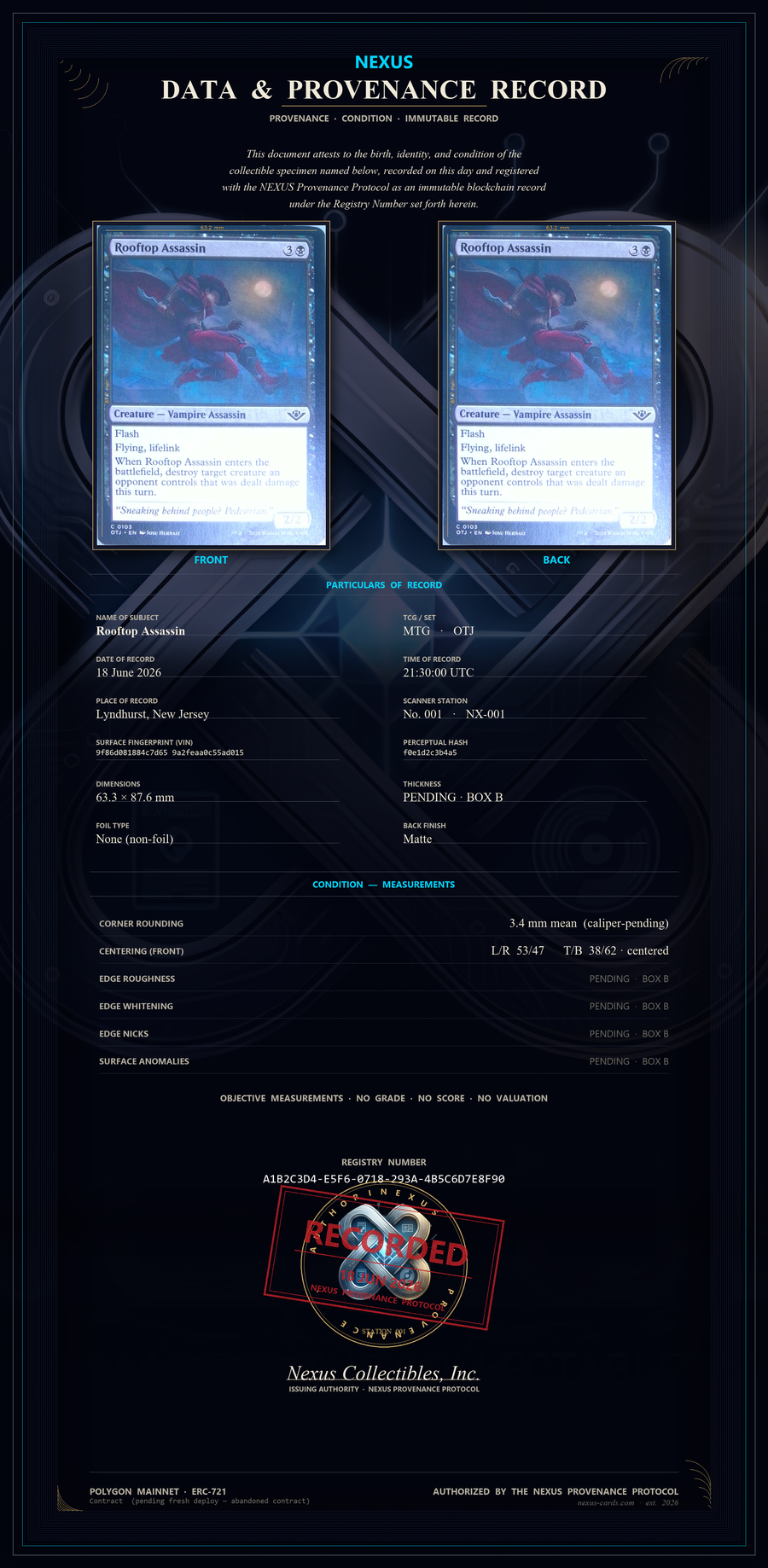
What the record actually looks like.
Everything on this page ends up here — the measurements, the fingerprint, the station that took them and the time it happened, on one document that travels with the object.
The same problem, with a worse cost of being wrong.
A property room already keeps a chain of custody; what it usually cannot keep is a measurement of the object’s state at each handoff. An append-only record of what was there, and what condition it was in, is the same instrument pointed at a higher stakes question.
Let's talk about your floor.
Tell us what moves through your counter and we will walk you through what a unit does with it — throughput, footprint, integration and terms.
Request a deployment briefing